
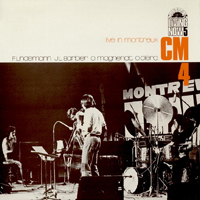
Jean-Luc Barbier & François Lindemann
«Live at the Montreux Jazz Festival»
The will to free themselves from harmonic, melodic and rhythrinc boundaries which informs most present day young jazzmen brings back the above-mentionned balance problem. The members of CM4 have coped with it by means of the musical inteqrity shown by their work in this record. The structures and articulations of For John Tchicai, for instance, stand out clearly through the rhythmic fluctuations, the transformations and overlappings of melodic lines and the passages where improvisers are let free. There is a rhythmic pattern gradually gaining shape under the alto recitative: it brings forth the rhythmic figures that allow the piano’s affirmation when it soloes. These figures, developed through the bass solo, precede the return of the alto, which ends the piece with a niew recitative. The symmetry between end and beginning as well as the repeated and modified rhythmic patterns act as a framework both for the musicians’ improvisation and the listeners’attention. Similar, though adapted to the character of each piece, features are to be found throughout the music in the record.
The evident admiration the members of the group have for leading American musiciens such as McCoy Tyner, John Coltrane, Jackie Mc Lean, Richard Davis and Elvin Jones, has stimulated the expression of their own musical personalities, while strengthening the quartet’s cohesion. For balance befween individual and collective expression is yet another constant feature in the history of jazz.
Demètre Ioakimidis
(transl. by Gimelfarb)